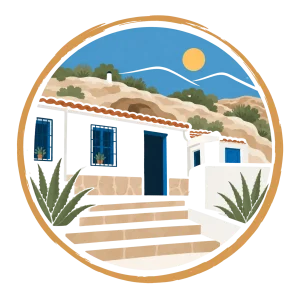
Cave house in Spain: why it stays cool in August
Look up cave houses in Spain and you mostly find two things: photographs of Guadix, and property listings. This is neither. It is what a cave house actually is, why the temperature inside behaves the way it does, and what the first night is like.
Dug out, not buried
The distinction matters. A cave house is not a house that was built and then covered over with earth. The rooms are cut into the hillside, one behind another, and what faces the world is a front wall, some windows and a courtyard. No foundations, no roof structure, nothing propping it up: the house is the hill with material taken out of it.
That is where the vaulted ceilings come from. An arch is what holds rock up without beams, so every room won from the slope has to close over itself. The walls are limewashed, and not for looks: lime lets the stone breathe, keeps it clean, and throws light back inwards — which is exactly what a windowless room is short of.
Why it stays cool through August
Rock has enormous thermal mass. It takes a very long time to warm up, and just as long to cool down. A metre underground, the ground stops following the air temperature and settles near the local annual average.
Step in out of a Spanish August and you feel it on the threshold, with no air conditioning running anywhere. Come January, the same rock works the other way round.
But isn’t it damp?
It is the first thing everybody asks, and the answer is short: a well-ventilated cave is dry.
Rock does not «sweat». What happens in sealed-up caves is that the moisture from breathing, cooking and showering has nowhere to go, so it condenses on the coldest surface it can find. With an open frontage and air moving through, it never gets that far.
It is the reason a lived-in cave house keeps well while an abandoned one falls apart. What keeps it healthy is being used.
The dark, and the quiet
Two things catch people out on the first night, and both are worth knowing before you book.
The dark is complete. A carved room has no window to the outside, so when the light goes off you genuinely cannot see your hand. Some people sleep better than they have in years; if you like waking up with the daylight, ask for a room in the built part of the house.
So is the quiet. A metre of stone does not pass the wind, the road, or the neighbours.
Where the cave houses are
The best known are in Andalusia — Guadix, Baza, and the Sacromonte in Granada — with more in Almería, Jaén and Albacete, and a few on Gran Canaria. Guadix is the one most people have seen in pictures: whole neighbourhoods underground, with whitewashed chimneys coming up out of open ground.
In the Murcia region there are far fewer, and almost none to rent. The north of the province, towards Abanilla and Fortuna, keeps a handful cut into the travertine hills.
Before you book one
Temperature is not something you set, it is something you inherit. A cave runs a long way behind the weather: it does not heat up because there is a heatwave, and it does not freeze because there is a frost. In August that is the whole point. In January it means the stone is not cold, but it is not warm either, and an hour of heating when you arrive is welcome.
Expect steps, too. A house cut into a slope follows the slope, and very little of it is on one level.
Sleeping in a cave house in Murcia
Los Carujos is in Barinas, a hamlet of Abanilla, 35 minutes from Murcia and under an hour from Alicante. Three bedrooms — two carved into the rock, the main one in the built part — and a private pool, 6 by 4 metres and 1.60 m deep. You book directly, with no agency in between.
There is plenty around it: things to do nearby, from badlands desert to hot springs, by way of a river with bathing pools.