Calle Los Carujos 39, Barinas · Abanilla · Región de Murcia
Cave house in Spain with a private pool
A cave house for four with a private pool and a garden above the village, in Barinas, Murcia. 35 minutes from Murcia city, an hour from Alicante.
- Sleeps
- 4 guests
- Bedrooms
- 3
- Bathrooms
- 1
- Size
- 64 m²
- Check-in
- 16:00
- Check-out
- 11:00
- From
- 80 € per night
Carved into the hillside, cool in the heat of August
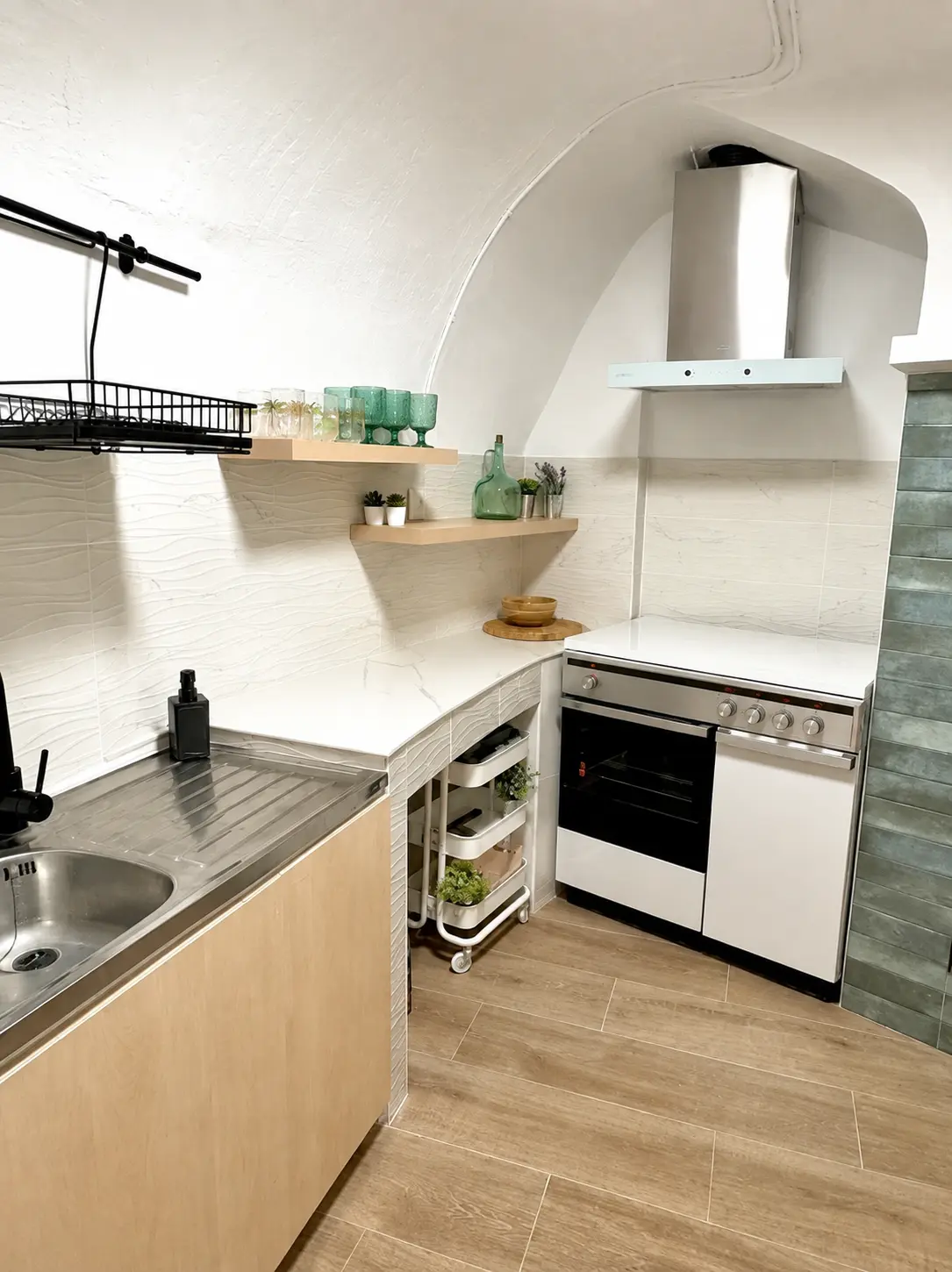
Los Carujos is a real cave house: its heart is cut into the hillside above Barinas, not built and then buried under earth. Over the years a whitewashed built section was added — the part you see from the lane — and it now holds the main bedroom. Sixty-four square metres in all.
If this is your first time, it is worth knowing what a cave house actually is: why the rock holds the cool right through August with no air conditioning, and what a metre of stone does to the silence.
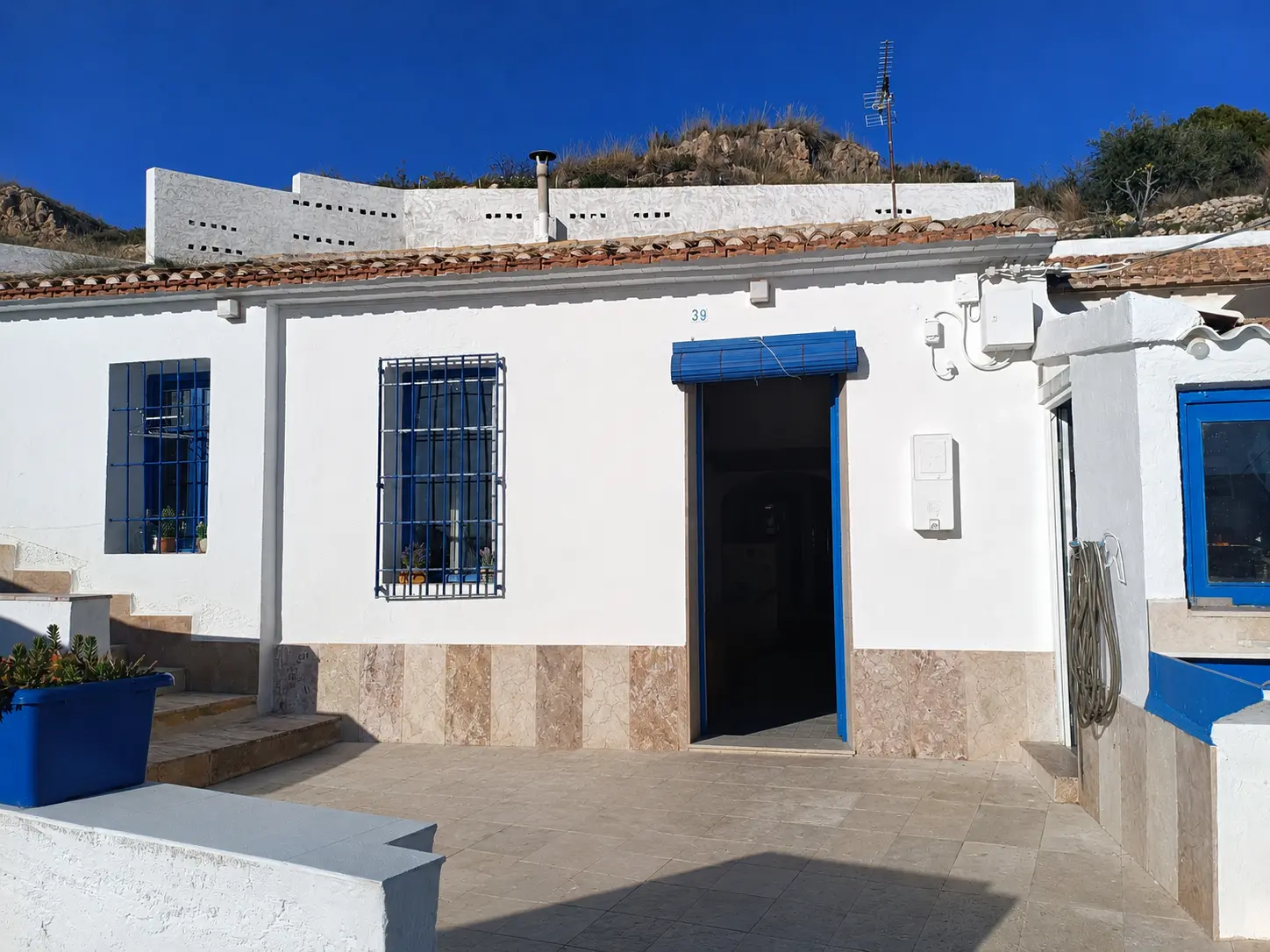
The rock does the work that a machine does in other houses: cool inside when the sun is hammering outside, mild when winter comes. No noise, no draught, none of that background hum you only notice once it stops.
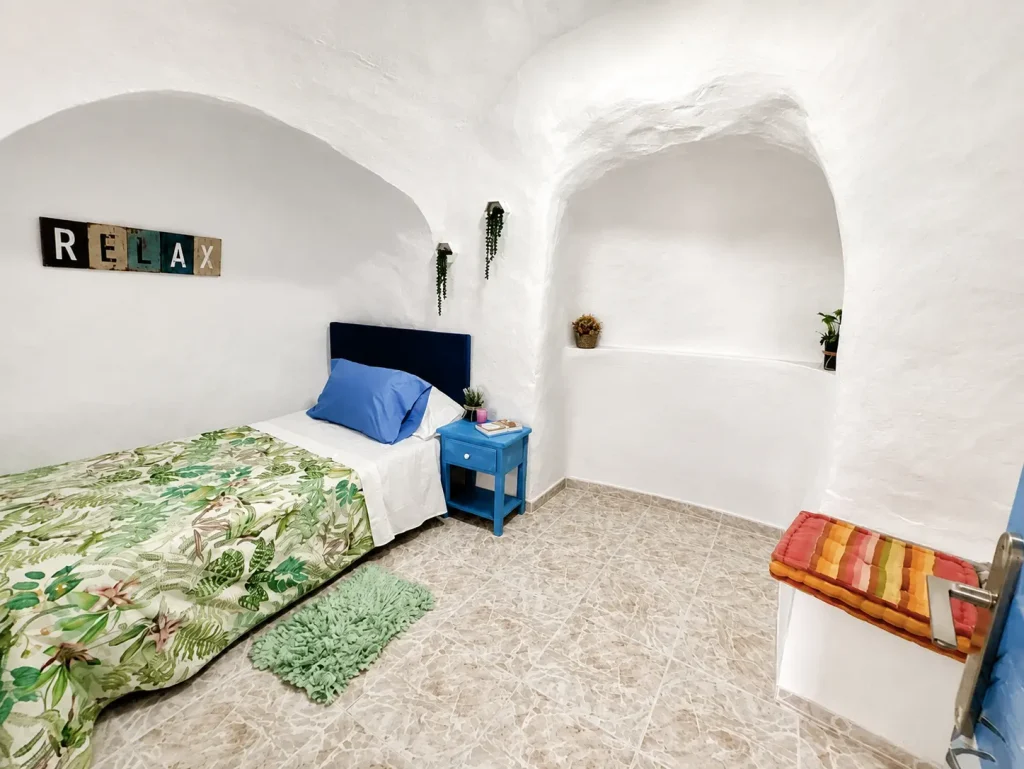
Three bedrooms, and not alike: two are carved into the rock, where the silence is complete and the temperature never moves all year; the main one is in the built section, brighter, with a window to the outside. Take your pick, night by night.
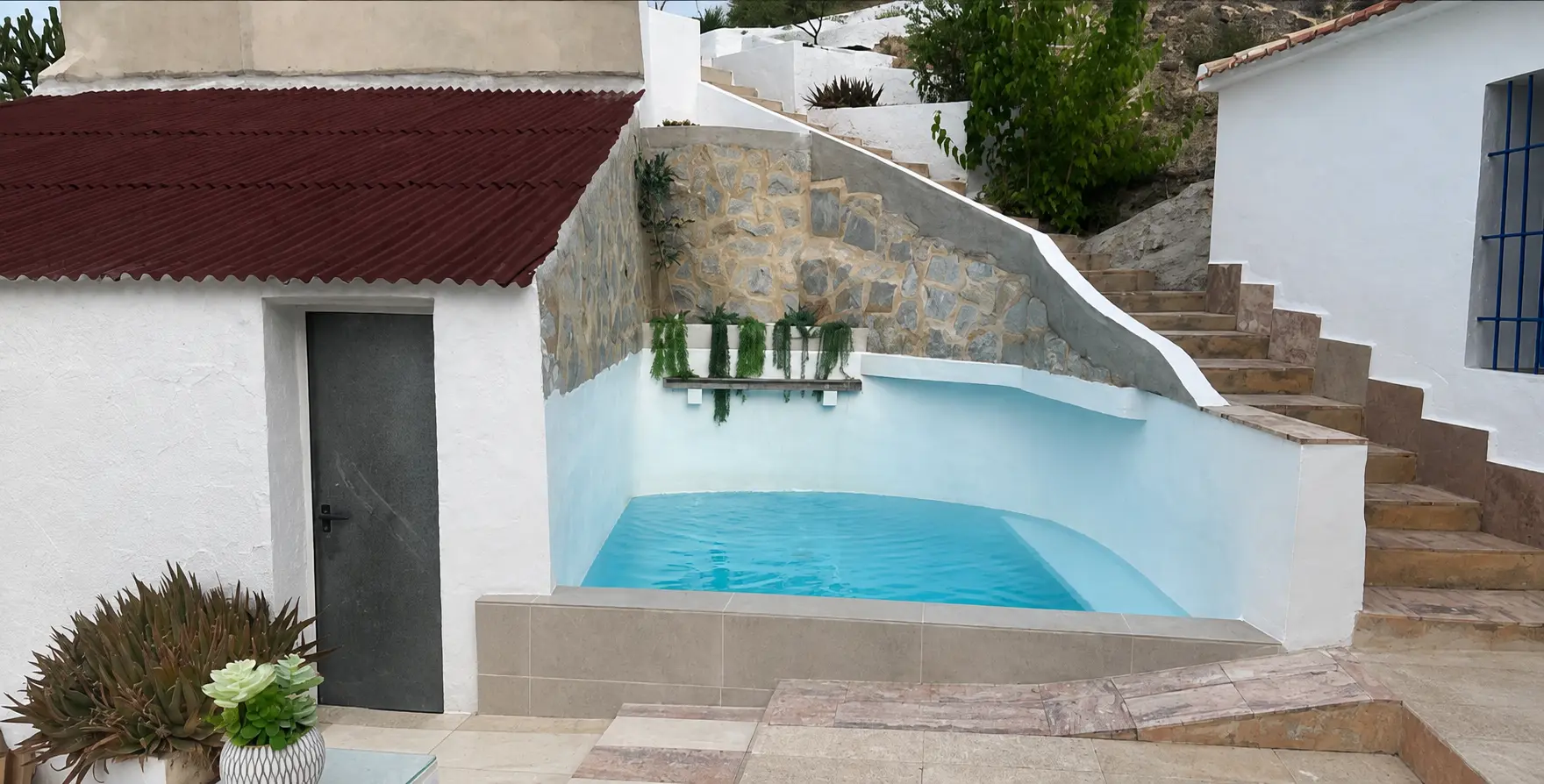
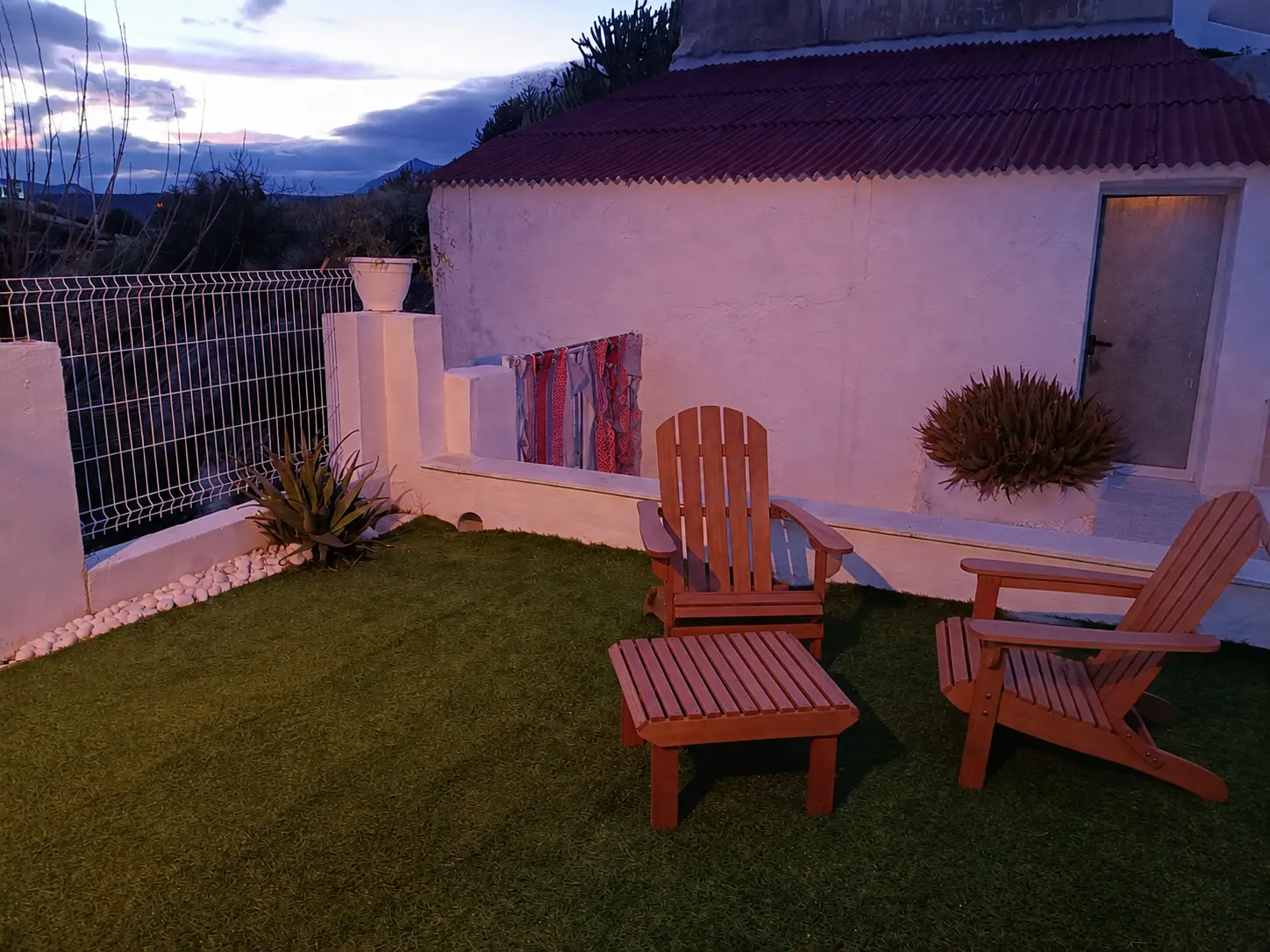
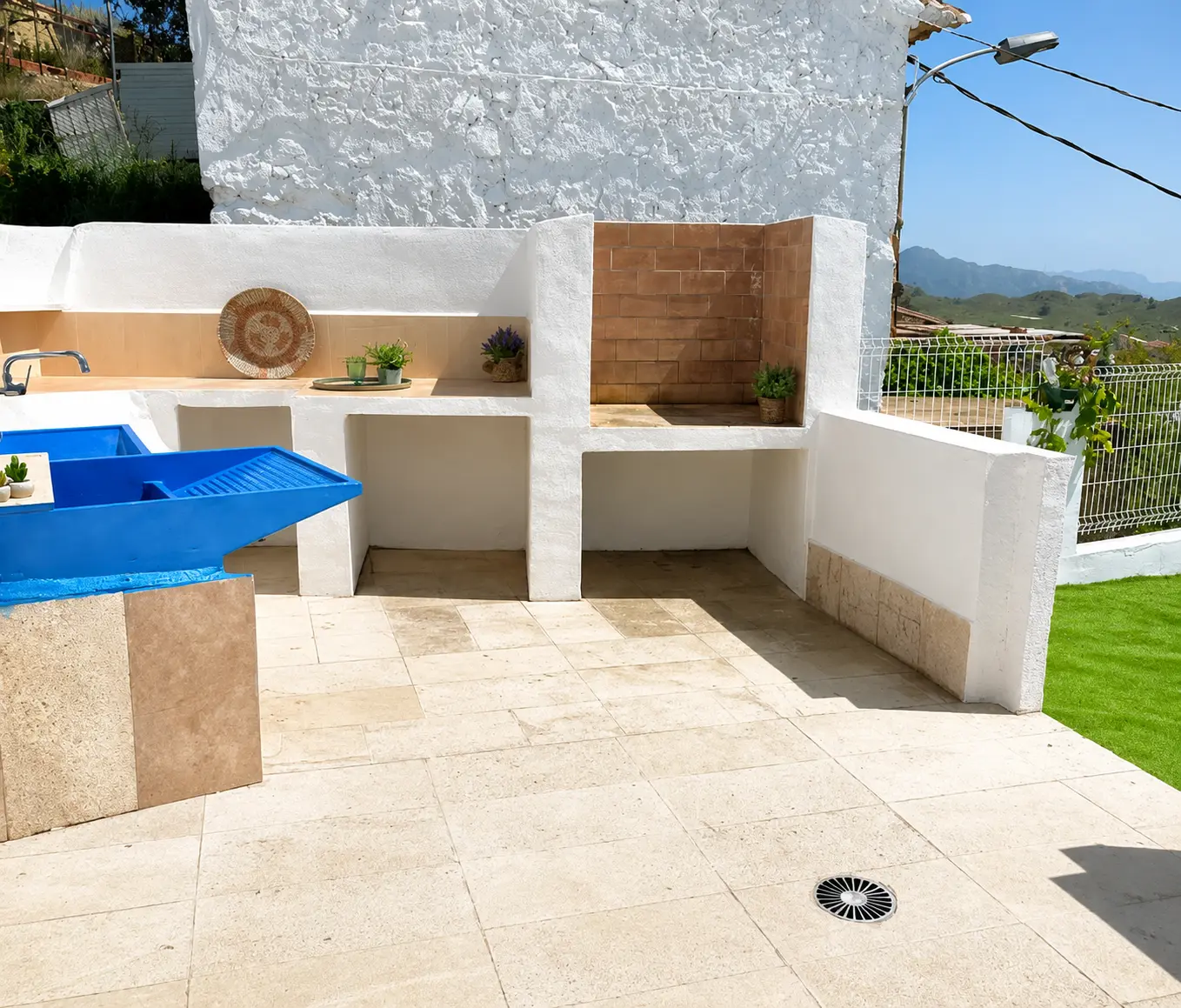
A fitted kitchen, a marble terrace, part of it red Alicante marble, a shaded sitting area and a barbecue. And the pool, private in the real sense: six metres by four, 1.60 m deep, and only the people sleeping here use it. Beside it, on the lawn, a second place to lie down for the hours when you do nothing at all.
A whole village at your feet
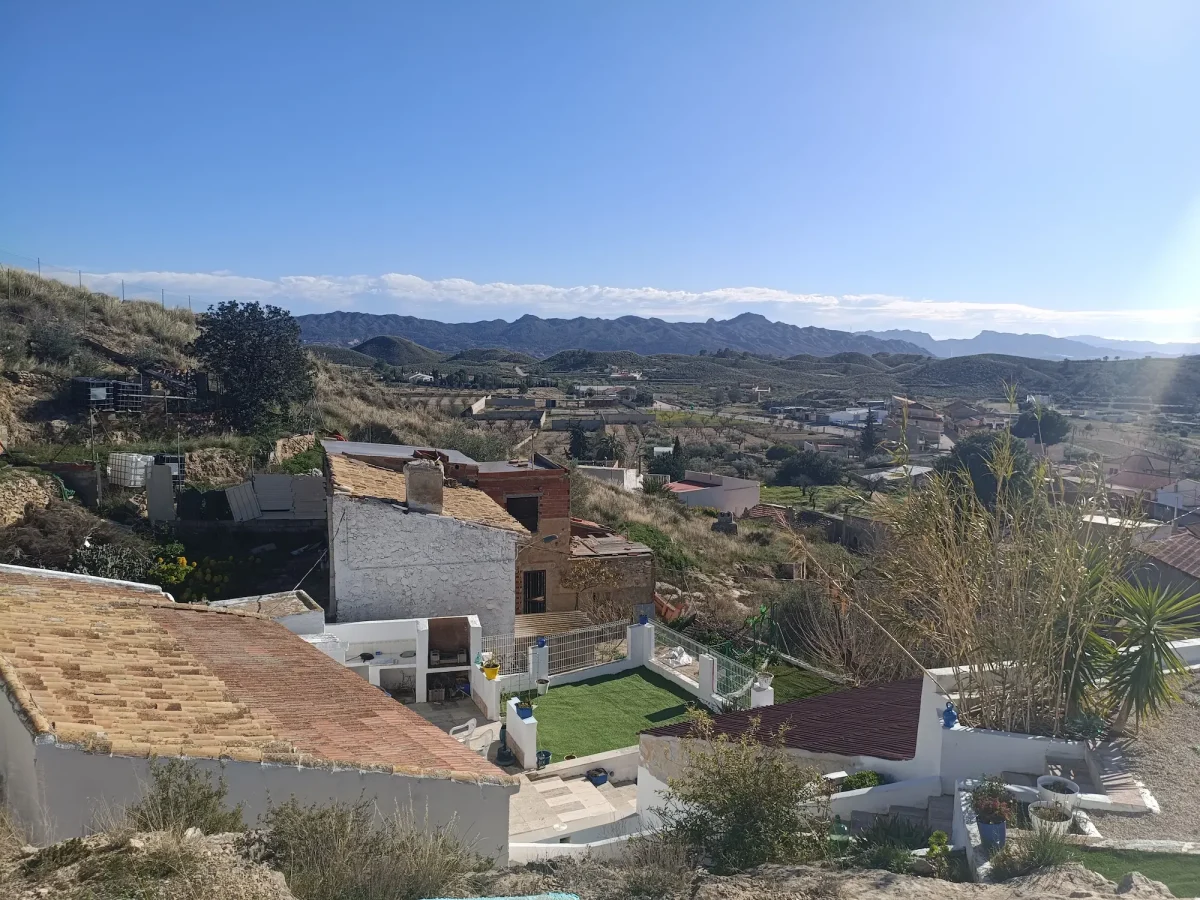
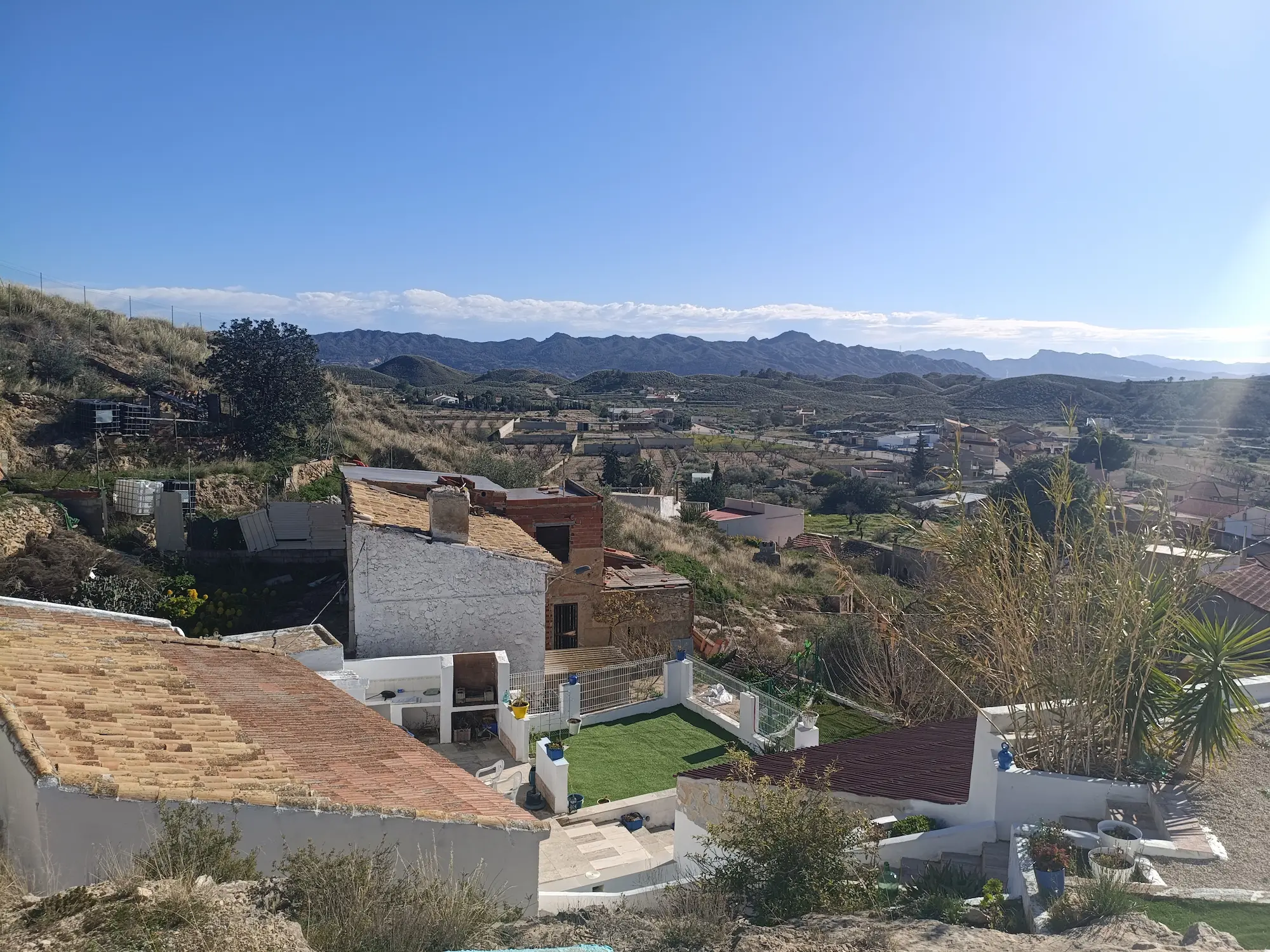
The house sits high up, near the Sacred Heart statue, leaning over the village. From the pool, a few steps climb to the private parking, and from there, past the fish pond, a blue staircase leads up to the top garden.
It is already laid out, and a second sitting area looks out over the whole of Barinas — the church, the rooftops, the statue — and behind it open country all the way to the sierra. This is where summer evenings end. A little higher still, a small orchard: olive, lemon, orange and fig trees, and a pomegranate. And, if the mood takes you, where you can sleep out under them.
Inside
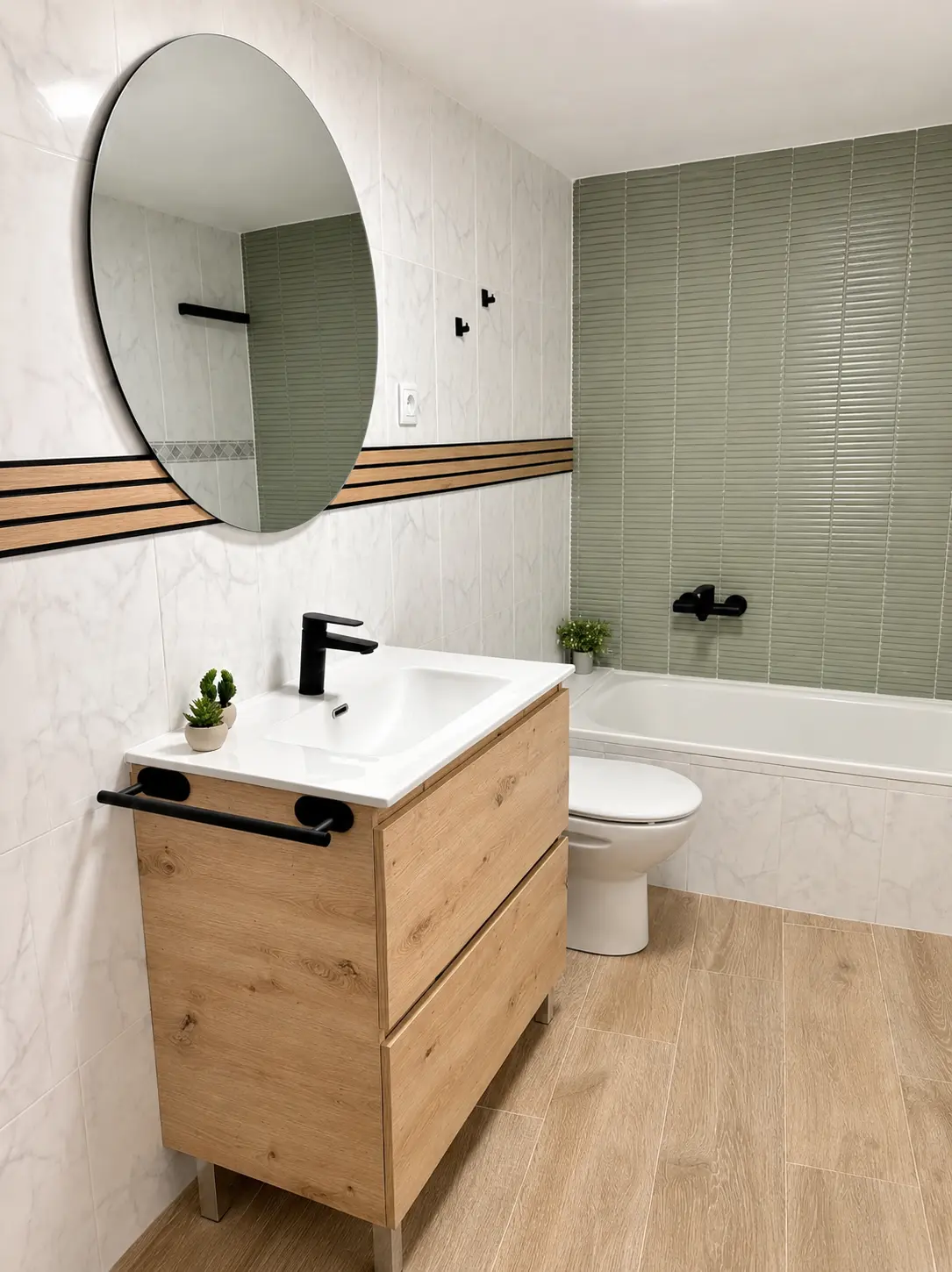
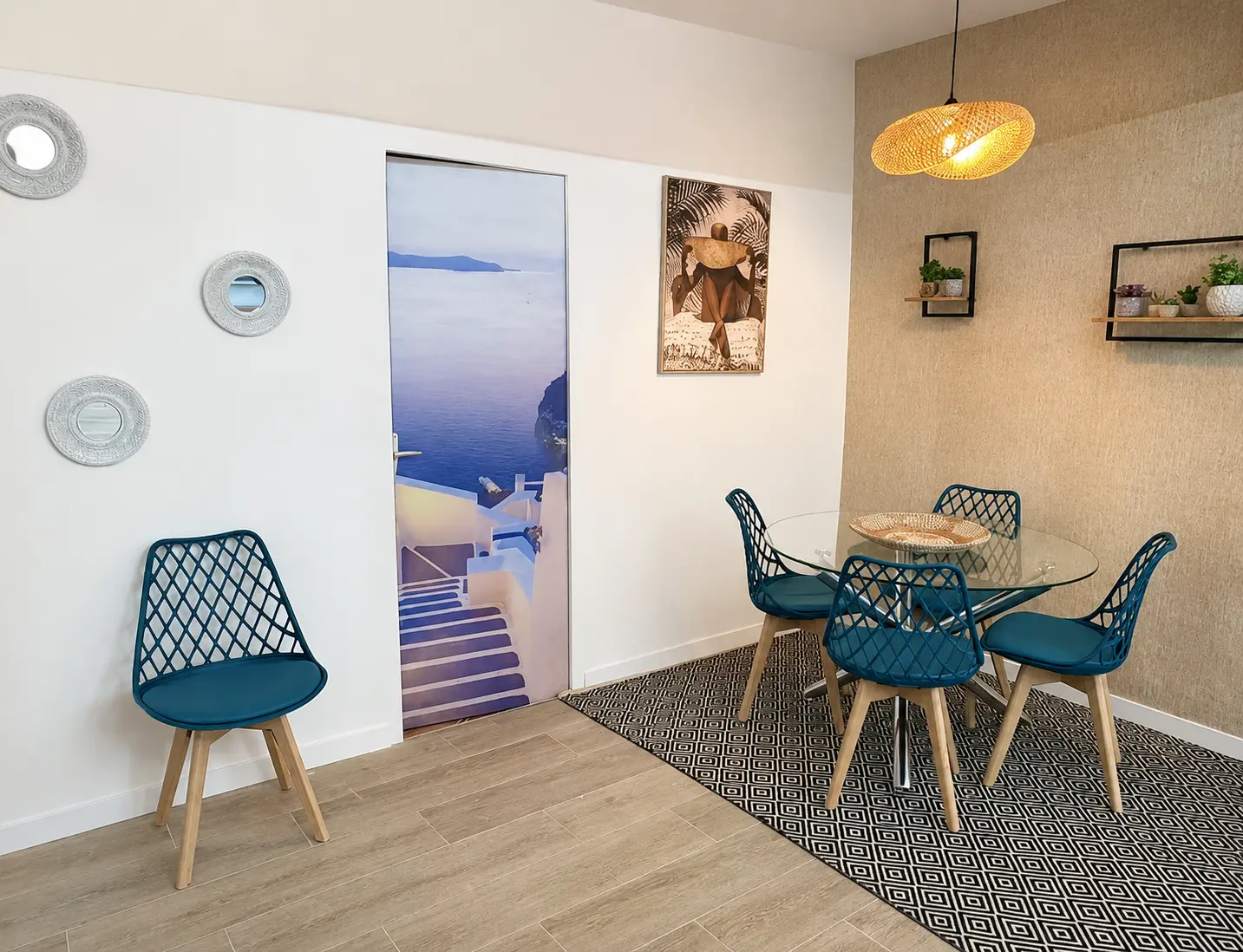
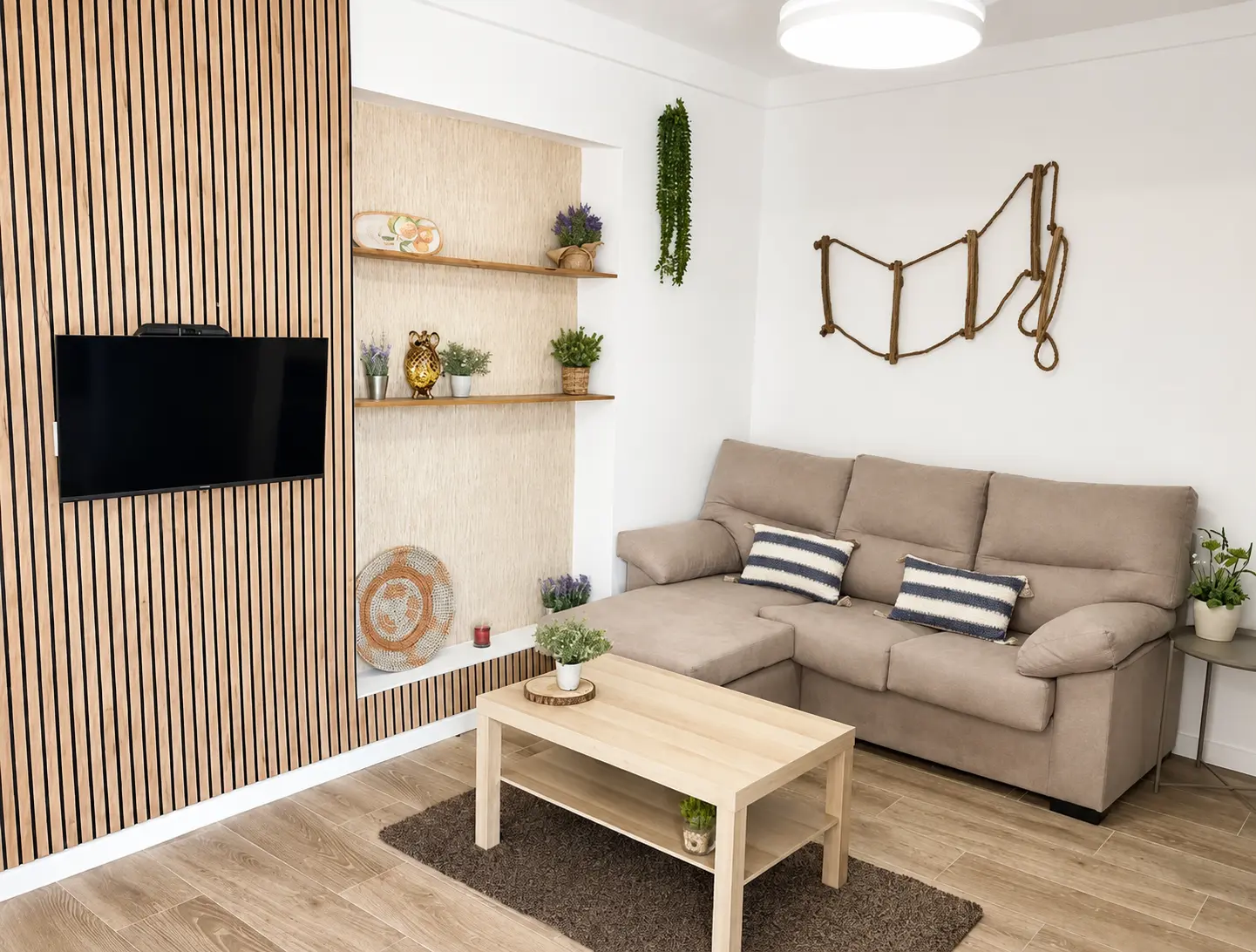
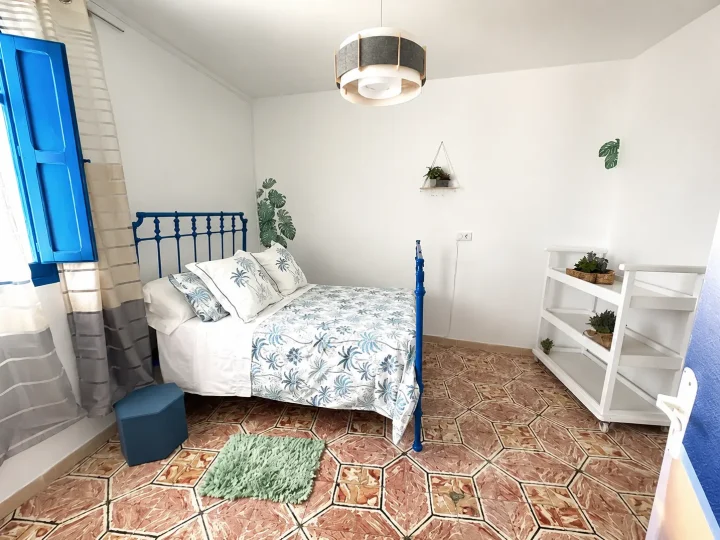
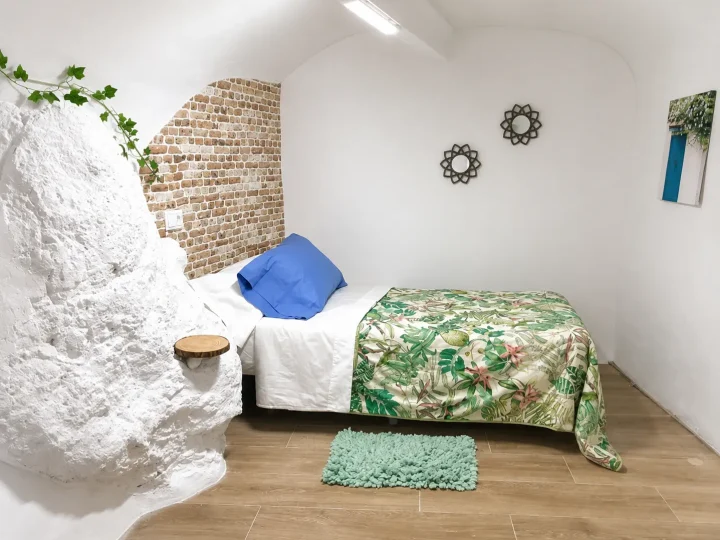
Whitewashed rock, vaulted ceilings, the patterned tiles of the main bedroom, and the summer kitchen on the terrace facing the valley.
Bedrooms
-
Main bedroom · 160 cm bed · in the built part
-
Second bedroom · 135 cm bed · carved into the rock
-
Third bedroom · single 80 cm bed · carved into the rock
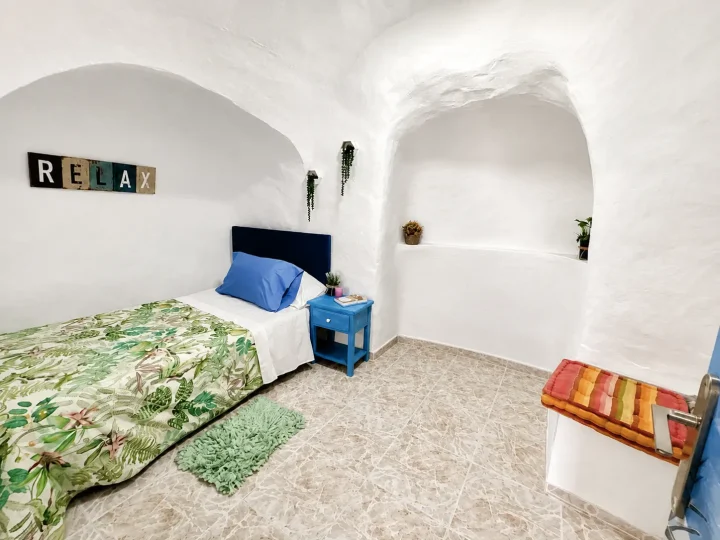
Three bedrooms for four guests — nobody sleeps in the living room. Two are carved into the rock; the main one is in the built section.
What’s included
- Private pool, 6 × 4 m
- Red Alicante marble terrace
- Summer kitchen with barbecue
- Fitted kitchen
- Living room with television
- Lawn area
- Satellite Wi-Fi (Starlink)
- Free parking
- Top garden overlooking the village
The village, on foot from the door
Being up high doesn’t mean being cut off — the village is a short walk downhill. Barinas has eight hundred residents and exactly what you need: a bakery, a tobacconist, a bank and a small supermarket, butcher’s counter included, that somehow stocks everything. No more, no less.
And on Tuesday mornings, the market: seasonal fruit and vegetables, two minutes from the door.
Leave the car where it is and you can walk a loop right around the village, between olive, almond and fruit trees, on a track that ends at the football pitch and a padel court.
Shopping, and market days
For a proper shop there are two options, both a quarter of an hour away.
Fortuna, with its supermarkets and its Saturday morning market. And Pinoso, just over the line into Alicante province, with supermarkets and a covered market hall — Saturday mornings too. You go for the market and end up staying for everything else.
And on Sundays, Algueña, just as close, fills the Plaza de España with its street market: fruit and vegetables from the huerta here, clothes, basketware, from half past eight to half past one. With the Tuesday market in Barinas and the Saturday ones in Fortuna and Pinoso, the week more or less plans itself.
The wine route starts next door
Pinoso, a quarter of an hour away, is where the Alicante Wine Route begins. La Bodega de Pinoso has occupied the same brick building since 1932 and is now the largest producer of organic wine in the Valencian Community; visits are by appointment. Around it, Volver, El Sequé and others open their cellars for tastings and walks through the vines.
Forty kilometres away, Jumilla is a different order of thing: a denomination of origin since 1966, the oldest in the Region of Murcia, and the largest Monastrell vineyard in the world. Fifteen wineries make up its wine route, most of them out in open country, most selling straight from the cellar door. There is even a wine museum, at the Hacienda del Carche.
Two separate denominations of origin, half an hour apart. That is not common anywhere.
Desert, oasis and Roman water
The Mahoya desert starts at the doorstep: gullies, badlands, a landscape people call lunar and which was a sea floor four million years ago. The waymarked PR-MU 74 crosses it in eight kilometres and drops into the El Cajer canyon.
Through the middle runs the Chícamo river, an oasis in dry country. Its ravines hold the greatest concentration of rambla palm groves in the whole Region of Murcia, and much of the walk is done ankle-deep in water. It is the outing everyone talks about afterwards.
A quarter of an hour away, Fortuna and its thermal springs. The Leana spa is built over Roman baths from the first century BC, and beside it opens the Cueva Negra, a pagan sanctuary whose Latin inscriptions painted onto the rock — the tituli picti — still keep archaeologists busy. After a day in the hills, hot water does more good than anyone cares to admit.
In Pinoso itself: the eighteenth-century church of San Pedro Apóstol, the clock tower, and the hermitage of Santa Catalina on its hill. Higher up, Monte Coto climbs to 900 metres through pine and holm oak, and the Cabezo de la Sal shows its red and white salt walls. The food is gachamiga, rice with rabbit and snails, and the local cured sausage.
From late January into March the almond blossom changes everything. It is probably the finest time of year to come — and the least crowded.
None of this is in the brochures. This is everyday Spain — the kind you live in rather than tour.
Murcia city, 35 kilometres away
The old town is walkable, and most of it sits within five streets: the cathedral, Gothic inside, with a Baroque façade that looks like an altarpiece stood on end; the nineteenth-century Real Casino, with its Moorish courtyard and English library; and the Salzillo museum, which holds the processional figures carried through the streets at Easter.
Tapas are eaten standing up, in Plaza de las Flores and Plaza de Santo Domingo, at no particular speed. Worth trying: michirones, dried broad beans stewed with chorizo and ham bone, with a kick; the marinera, a ring of bread piled with Russian salad and topped with an anchovy; zarangollo, courgette and onion with egg; Murcian meat pie; and fresh boquerones. For pudding, paparajotes — lemon leaves dipped in batter and fried. You don’t eat the leaf, though everyone tries once.
If you can pick your dates, come in spring. Murcia’s Semana Santa is a Festival of International Tourist Interest, and straight afterwards come the Spring Festivals: the Bando de la Huerta on the Tuesday after Easter, when the whole city dresses as market gardeners, and the Entierro de la Sardina, which closes them on the Saturday with floats and fire. Barinas is half an hour away: go down, join in, come back up to the quiet.
Murcia in detail, and everything else around, from nearest to furthest.
Getting here
Barinas is 35 minutes from Murcia and an hour from Alicante by car. Alicante-Elche airport is under 50 minutes away, Murcia’s, at Corvera, 45. Free parking at the door. You need the car to explore the area; to walk down to the village, you don’t. The house is spread over several levels linked by steps, so it is not suitable for guests with reduced mobility.
For your GPS. The house number cannot be seen from the street, so the simplest thing is to enter C. Corazón de Jesús, 30648 Barinas, Murcia and take that street. Open in Google Maps.
- At the end of the street, turn right and keep straight on a road that climbs.
- You pass the Sacred Heart statue, on your right.
- You come to an olive tree where the track forks: one ahead, one to the left. Take the one ahead.
- It is a short, very steep climb; at the top is the house parking.
We send you these same directions, with photos of the track, before you arrive.
And the sea, fifty minutes away
The house is inland, but the coast is not far: about fifty minutes by car to the beaches of the Costa Cálida and the Mar Menor, calm shallow water that suits children. At San Pedro del Pinatar there are the salt pans, with their flamingos and their mud baths. Go in the morning, come back to sleep in the cool of the rock.
The practical things, so you don’t have to ask
- Check-in from 4 pm; check-out by 11 am.
- Bed linen, towels and tea towels provided.
- Pets welcome, at no extra charge.
- Utility room with washing machine, freezer and clothes airer. Fitted kitchen and barbecue.
- No air conditioning — the rock does that job: ceiling fans in the living room and a fan in every bedroom.
- Gas heating in winter. Hot water and the cooker also run on butane bottles.
- Private parking for two cars.
- Satellite Wi-Fi (Starlink) and television.
The pool is not heated. Depending on the year, it is good from April to early October.
With small children, worth knowing before you arrive: the pool is not fenced, the top garden has a fish pond, and the levels are linked by steps.
Frequently asked questions
What exactly is a cave house?
It’s a dwelling dug into the rock, not a house built and then covered with earth. The rooms are cut into the hillside, with a façade, windows and a courtyard outside. It’s a way of living particular to south-eastern Spain, and still one of the cleverest answers to heat.
Is it cold or damp inside the cave?
No. The rock holds a steady temperature all year. In summer you feel it the moment you step inside; in winter that same rock is what insulates. Cross-ventilation keeps damp away.
How many people can stay?
The house sleeps four, across three bedrooms: a 160 cm bed in the built section, and two rooms dug into the rock, with a 135 cm bed and a single 80 cm bed. It’s made for a family or a small group, not for large celebrations.
Is the pool just for the house?
Yes. The pool is private and used only by guests staying at Los Carujos. It isn’t shared with any other property.
Do you actually sleep inside the rock?
In two of the three bedrooms, yes: they’re dug into the hillside, with no window to the outside, with the stillness and steady temperature only stone gives. The main bedroom, by contrast, is in the built section and has a window. If you want the full experience you sleep in the rock; if you’d rather wake with the light, there’s somewhere for you.
Is it suitable for guests with reduced mobility?
No, and we would rather say so before you book. The house is cut into the hillside and spread over several levels: from the parking you go down to the house and the pool, and the top garden is reached by a staircase. There is no step-free route.
Where is it, and how do you get there?
In Barinas, a hamlet of Abanilla, in the Region of Murcia. It’s 35 minutes by car from Murcia and an hour from Alicante. Alicante-Elche airport is under 50 minutes away, Murcia’s, at Corvera, 45. A car is essential for getting around the area; for walking down to the village, it isn’t.
What is there to do nearby?
Walking and cycling in the Mahoya desert and the sierra, the thermal baths at Fortuna a quarter of an hour away, the old centre of Abanilla, the wines and the food of Pinoso, and the almond blossom between late January and March, which is probably the finest time of year to come. And the sea, about fifty minutes away: the beaches of the Costa Cálida and the Mar Menor.